
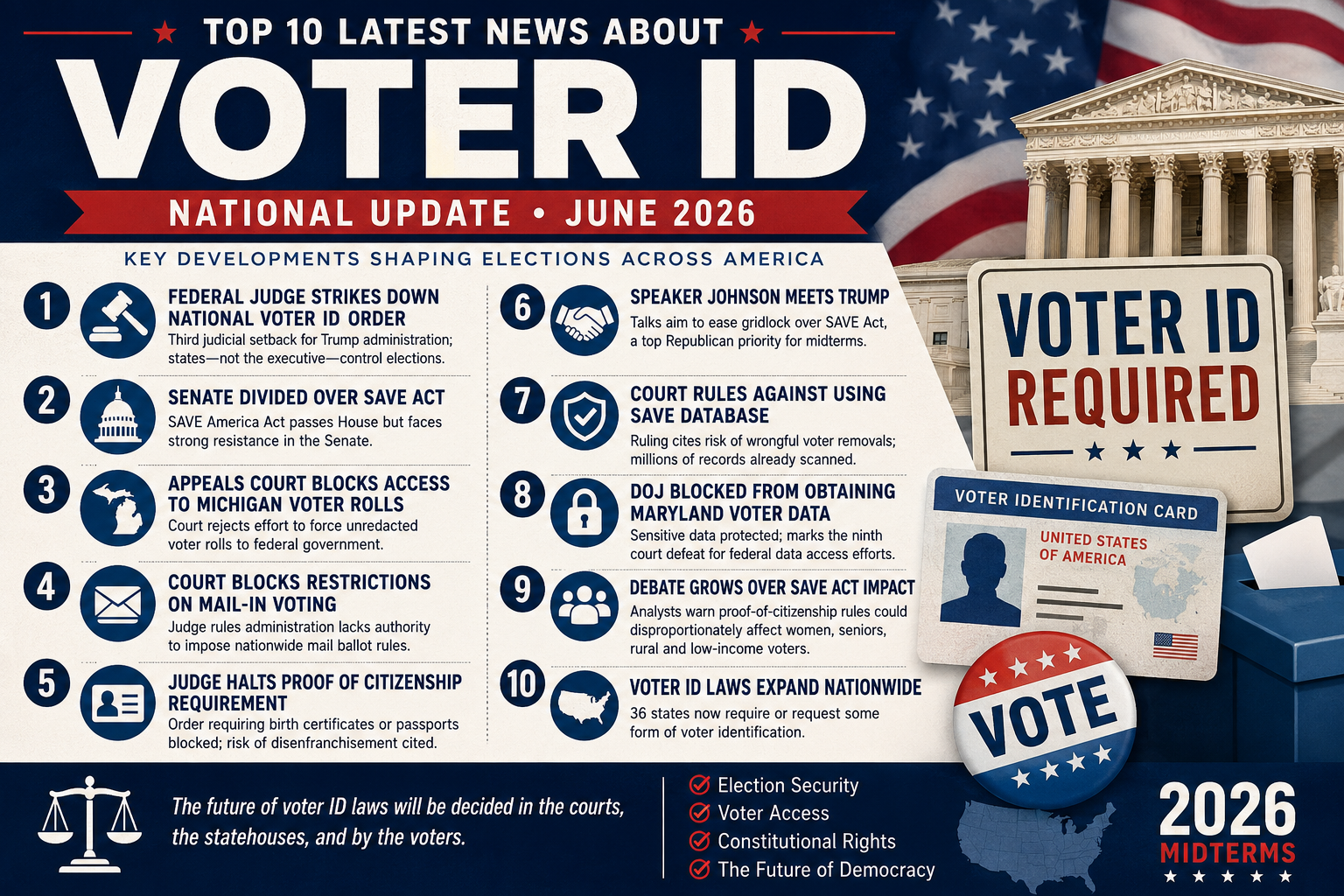
Welcome to our fifteenth “Voter ID News Hotsheet”, where we summarize all the latest Voter ID news on a National basis in a monthly digest of top happenings.
As the 2026 midterm election season intensifies, voter ID laws and election integrity measures have become one of the most debated political topics across the United States. Courts, lawmakers, advocacy groups, and election officials are all weighing in on proposals involving photo identification, proof-of-citizenship requirements, mail-in voting restrictions, and federal access to voter data. June 2026 has seen a rapid series of legal rulings and political battles that could significantly shape how Americans vote in future federal elections.
-
- A federal judge struck down a major executive order tied to national voter ID enforcement, marking the third judicial setback for the Trump administration’s election overhaul efforts. The ruling emphasized that states — not the executive branch — primarily control election administration. Read More
-
- The U.S. Senate remains divided over the proposed SAVE America Act, a sweeping federal voter ID bill requiring proof of citizenship and photo identification for federal elections. Despite House approval earlier this year, the bill faces major resistance in the Senate. Read More
-
- A federal appeals court rejected efforts to force Michigan to provide unredacted voter rolls to the federal government. Privacy advocates hailed the ruling as a major protection against federal overreach into state election systems. Read More
-
- A Boston federal court blocked a proposed federal restriction on mail-in voting tied to voter verification databases and immigration checks. The judge ruled that the administration lacked constitutional authority to impose nationwide election procedures without congressional approval. Read More
-
- Another federal judge halted an executive order that would have required documentary proof of citizenship — such as passports or birth certificates — for voter registration and registration updates. Voting rights organizations argued the policy risked disenfranchising millions of eligible voters. Read More
-
- House Speaker Mike Johnson attempted to ease tensions between Congress and President Donald Trump after legislative gridlock over the SAVE America Act stalled other federal legislation. The issue has become a central Republican priority heading into the midterms. Read More
-
- A federal court ruled against using the federal SAVE database to verify voter citizenship after concerns emerged that lawful voters could be incorrectly removed from voter rolls. Privacy advocates warned that millions of voter records had already been scanned. Read More
-
- Civil liberties groups celebrated a court victory blocking the Department of Justice from obtaining sensitive Maryland voter data, including partial Social Security numbers and driver’s license details. The decision marked the ninth court defeat for federal voter-roll access efforts. Read More
-
- National debate intensified over the broader implications of the SAVE America Act, with policy analysts warning that documentary proof-of-citizenship requirements could disproportionately affect women, rural voters, seniors, and low-income Americans who lack easy access to official documents. Read More
- Election policy organizations reported that voter ID requirements continue expanding nationwide, with numerous states revisiting or strengthening identification laws ahead of the 2026 elections. Current estimates show that 36 states now require or request some form of voter identification. Read More
The national conversation surrounding voter ID laws in June 2026 reflects a broader struggle over election security, federal authority, voter access, and constitutional rights. With multiple court battles ongoing and Congress sharply divided, voter identification policy is likely to remain a defining issue of the 2026 midterm election cycle. Both supporters and critics argue they are protecting democracy — but the final outcome may ultimately be decided by the courts, state governments, and voters themselves.