
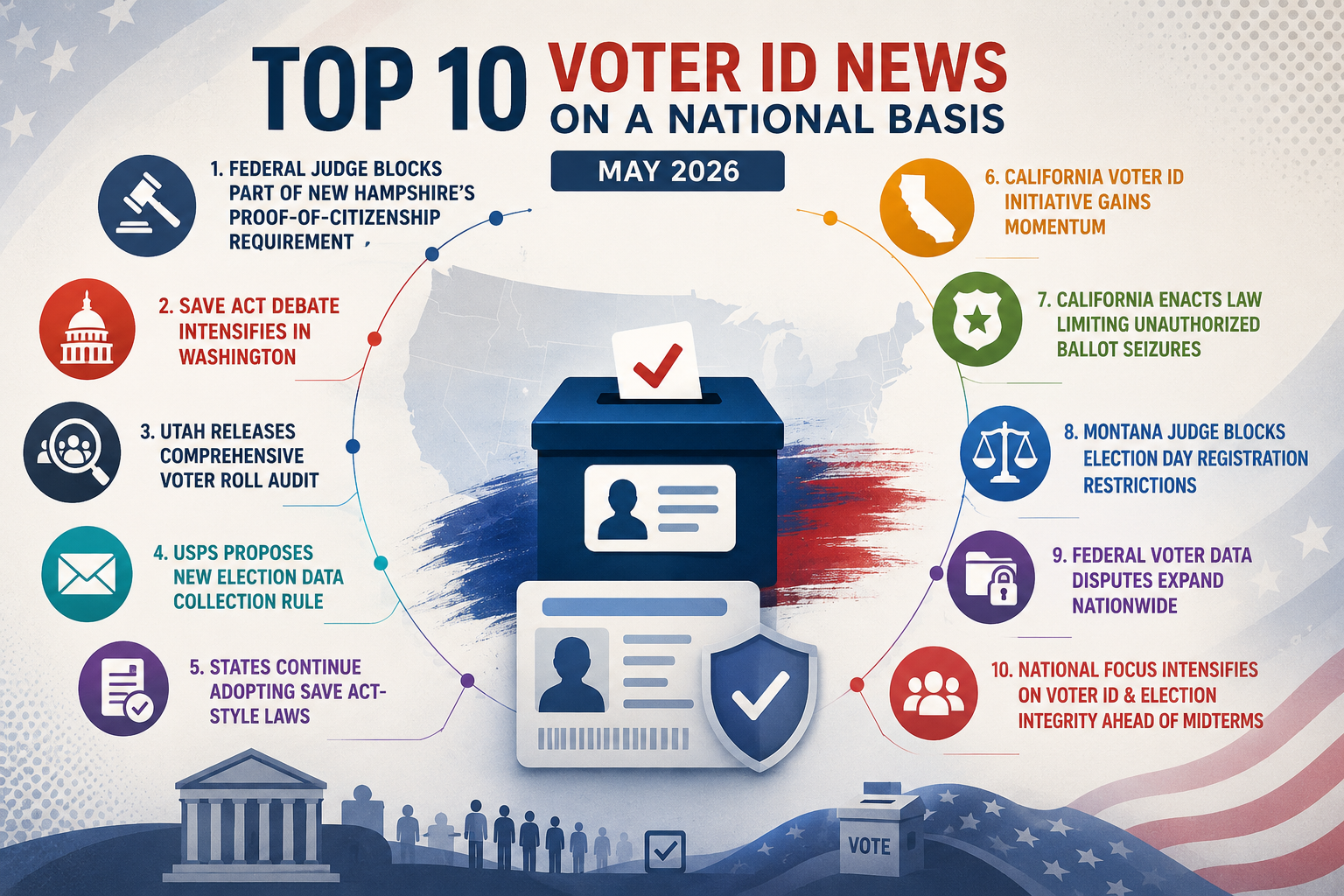
Welcome to our fourteenth “Voter ID News Hotsheet”, where we summarize all the latest Voter ID news on a National basis in a monthly digest of top happenings.
As the 2026 midterm election season accelerates, voter identification and proof-of-citizenship requirements remain among the most debated election issues in America. Throughout May, courts, state legislatures, federal agencies, and election officials grappled with questions surrounding voter eligibility verification, election integrity, voter access, and the expanding role of government in election administration. Here are ten of the most significant voter ID-related developments from across the nation during May 2026.
-
Federal Judge Blocks Part of New Hampshire’s Proof-of-Citizenship Requirement
A federal judge ruled that New Hampshire must again allow voters to use sworn affidavits when registering if they do not possess documentary proof of citizenship. The court found that the state’s stricter documentation requirements could improperly burden eligible voters and potentially disenfranchise thousands of citizens. Read More
-
SAVE Act Debate Intensifies in Washington
The federal Safeguard American Voter Eligibility (SAVE) Act continued to dominate election policy discussions in May. The proposal would require documentary proof of U.S. citizenship when registering to vote in federal elections. Supporters argue it strengthens election integrity, while opponents contend it could create barriers for eligible voters lacking readily available documents. Read More
-
Utah Releases Comprehensive Voter Roll Audit
Utah officials published the results of an extensive voter roll audit, reporting that 99.72% of approximately two million registered voters were confirmed U.S. citizens. The audit became a focal point in the broader national debate over voter registration verification and proof-of-citizenship requirements. Read More
-
USPS Proposes New Election Data Collection Rule
The U.S. Postal Service proposed a rule that would require states to provide information related to mail-ballot recipients and associated tracking data. Supporters say the proposal would improve election administration oversight, while critics argue it could expand federal involvement in election processes. Read More
-
States Continue Adopting SAVE Act-Style Laws
Several states moved forward with legislation requiring documentary proof of citizenship for voter registration, mirroring provisions contained in the federal SAVE Act. Election law experts say these measures could significantly reshape voter registration procedures ahead of future elections. Read More
-
California Voter ID Initiative Gains Momentum
A proposed California ballot measure that would require voters to present government-issued identification and strengthen voter list verification procedures continued advancing toward the November 2026 ballot. Supporters reported collecting sufficient signatures for qualification review. Read More
-
California Enacts Law Limiting Unauthorized Ballot Seizures
Governor Gavin Newsom signed emergency legislation restricting unauthorized ballot seizures by law enforcement agencies. The law was enacted after controversy surrounding ballot seizures in Riverside County and reflects growing national concern over election administration authority. Read More
-
Montana Judge Blocks Election Day Registration Restrictions
A Montana court temporarily halted a law that would have restricted Election Day voter registration opportunities. The ruling highlights the continuing legal battle over balancing election access with administrative safeguards. Read More
-
Federal Voter Data Disputes Expand Nationwide
The Justice Department’s efforts to obtain voter registration data from states continued generating legal disputes. Several states have resisted requests for detailed voter information, citing privacy concerns and state authority over election administration. Read More
-
National Focus Intensifies on Voter ID and Election Integrity Ahead of Midterms
Election policy organizations, legislators, advocacy groups, and courts spent May debating voter identification requirements, proof-of-citizenship standards, voter roll maintenance, and election security measures. With the 2026 midterm elections approaching, these issues are expected to remain at the center of election policy discussions nationwide. Read More
May 2026 demonstrated that voter identification and election eligibility verification remain among the most consequential issues shaping America’s election landscape. From federal court rulings and state legislative actions to ongoing debates over proof-of-citizenship requirements and voter roll maintenance, policymakers continue seeking the balance between election security and voter access. As the nation moves closer to the November midterm elections, these developments will likely influence both election administration practices and the broader national conversation surrounding voter confidence and election integrity.